For Irish SMEs across Donegal, Sligo, Dublin, and the wider island of Ireland.
A critical email, seemingly from your CEO, lands in your finance manager's inbox, instructing an urgent payment to a new vendor. Without a second thought, the payment is processed. Only later do you discover it was a sophisticated phishing attack, and your company has lost thousands, if not tens of thousands, of euros. This happens to Irish businesses every day. Traditional spam filters catch obvious threats, but they often miss the carefully crafted emails designed to impersonate legitimate senders. That is the gap DMARC, DKIM, and SPF close.
The limitations of traditional spam filters
For years, spam filters have been the frontline defence against unwanted and malicious emails. They analyse sender reputation, content, and attachments to flag suspicious messages. However, cybercriminals keep changing their tactics. They exploit weaknesses in email systems to "spoof" sender addresses, making a fraudulent email appear to originate from a trusted source within your organisation or a known business partner. This social engineering tactic, often called phishing or spear-phishing, bypasses many basic filters because the email content itself might not trigger red flags. The danger lies in the deceptive sender identity, which traditional filters struggle to verify.
Understanding SPF: Sender Policy Framework
SPF (Sender Policy Framework) is like a bouncer for your email domain. It allows domain owners to publish a list of authorised mail servers that are permitted to send emails on behalf of their domain. When an email server receives an incoming message, it checks the SPF record of the sender's domain. If the email originates from an IP address not listed in the SPF record, the receiving server knows it's likely a fraudulent email. Think of it as a public record stating, "Only these specific post offices are allowed to send mail with my return address."
In practice, the domain owner creates a DNS TXT record listing all authorised sending IP addresses. When an email is sent from the domain, the recipient's email server queries the sender's DNS for that SPF record and compares the sending IP address against the list. If there's a mismatch, the email might be flagged as suspicious, quarantined, or rejected.
Understanding DKIM: DomainKeys Identified Mail
While SPF verifies the sender's identity, DKIM (DomainKeys Identified Mail) goes a step further by ensuring the email's integrity during transit. It acts like a tamper-evident seal on your email. When an email is sent, it's digitally signed by the sending mail server using a private key. This signature is then attached to the email header. The corresponding public key is published in the domain's DNS records. The receiving server uses this public key to verify the signature. If the signature is valid, it confirms that the email has not been altered since it left the sender's server and that it genuinely originated from the claimed domain.
The setup follows the same pattern: a pair of cryptographic keys is generated, the public key is published in the domain's DNS records, and the sending mail server uses the private key to create a unique digital signature for each outgoing email, embedded in the email header. The recipient's email server retrieves the public key from the sender's DNS and uses it to verify the signature. An invalid signature indicates tampering or forgery.
Free Resource: Download The Irish SME Cyber Survival Guide. 10 controls based on NCSC Ireland & ENISA guidance. Plain English, no jargon.
Understanding DMARC: Domain-based Message Authentication, Reporting, and Conformance
DMARC (Domain-based Message Authentication, Reporting, and Conformance) brings SPF and DKIM together, providing a policy layer that tells receiving email servers what to do with emails that fail authentication checks. It also provides reporting back to the domain owner, showing who is sending emails on their behalf, both legitimately and illegitimately. DMARC allows domain owners to specify policies such as "quarantine" (send to spam), "reject" (don't deliver), or "none" (monitor only). This lets businesses take control of their email reputation and protect their brand from abuse.
The mechanics: the domain owner publishes a DNS TXT record specifying the DMARC policy and where to send reports. A receiving email server checks each incoming email against the sender's SPF and DKIM records. If both fail, or if one passes but the "alignment" (where the "From" address matches the authenticated domain) fails, the server takes the specified action. The receiving server also sends aggregate and forensic reports back to the domain owner, detailing authentication results and potential abuse.
The combined power: DMARC, DKIM, and SPF setup for your business
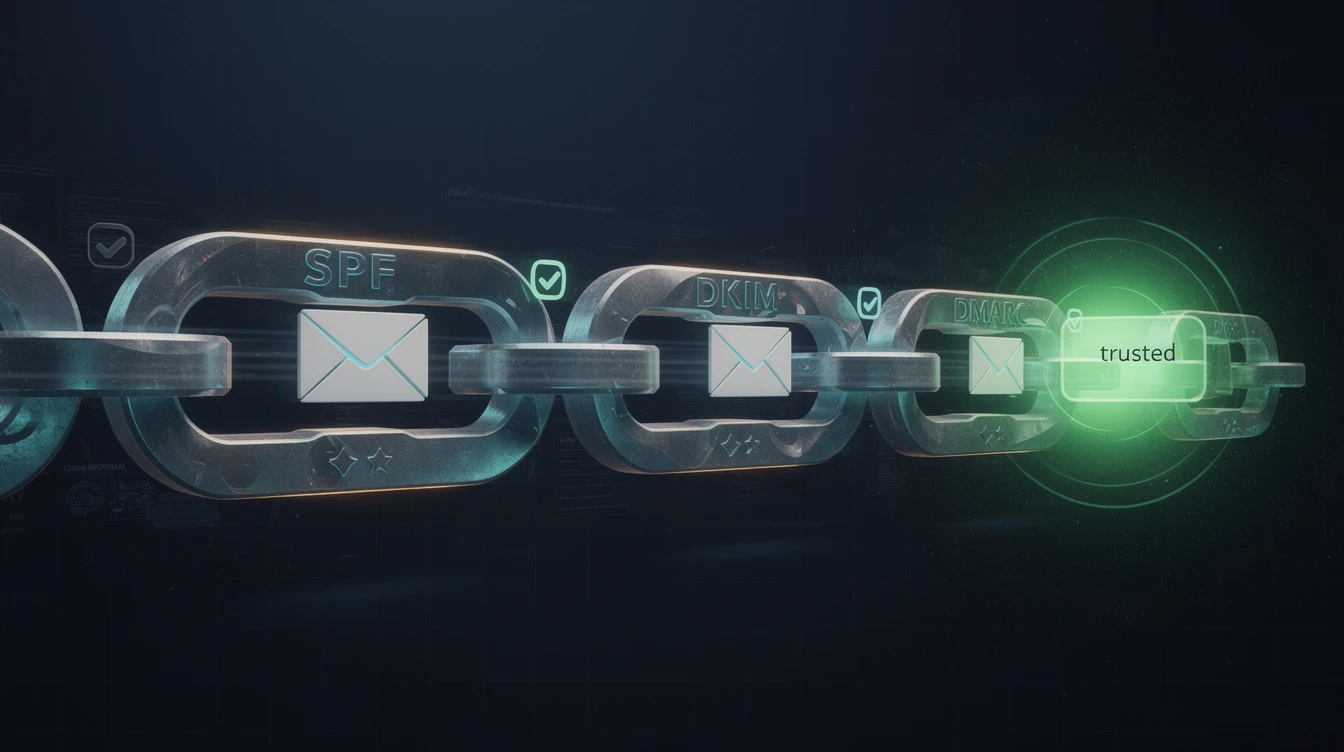
The strength of these protocols lies in their combined implementation. SPF verifies the sender's server, DKIM verifies the email's integrity, and DMARC handles the policy and reporting. For Irish SMEs, a working DMARC DKIM SPF setup is a core part of a sound cybersecurity posture. The National Cyber Security Centre (NCSC) Ireland consistently advises organisations to implement these measures to combat phishing and email spoofing, which remain prevalent threats to businesses of all sizes across the country.[^1]
By properly configuring these records, your business can reduce the chances of cybercriminals impersonating your domain, improve email deliverability so legitimate messages reach their recipients' inboxes, protect your brand's credibility from misuse in fraud, and gain visibility through DMARC reports into who is sending email in your name. Strong email security is not a direct regulatory requirement in Ireland, but it contributes to overall data protection and compliance with regulations like GDPR, which the Data Protection Commission (DPC) actively enforces.
What this means for your business
Implementing DMARC, DKIM, and SPF might seem technical, but the benefits far outweigh the complexity. For Irish SMEs, this means a significant reduction in the risk of email-borne attacks, protecting your employees, customers, and financial assets. It also means your important communications are delivered rather than filtered as spam.
How compliant is your business? Check your compliance readiness with our free Compliance Checker.
Ready to strengthen your security posture?
Pragmatic Security works with Irish SMEs to build practical, proportionate cybersecurity programmes that protect your business, satisfy regulators, and give you confidence. Whether you need NIS2 compliance support, a vCISO on retainer, or a one-off security assessment, we're here to help.
Book a free 20-minute strategy call today: no jargon, no hard sell, just practical advice from an experienced Irish cybersecurity professional.
Or contact us at [email protected] or call +353 (0)87 0515 776.
Related Reading
- Email Security for Irish Businesses: SPF, DKIM and DMARC Explained
- A Donegal Business Lost €47,000 in 48 Hours: Here Is Exactly What Happened
- DNS Security: The Overlooked Protection Layer for Small Businesses
[^1]: NCSC Ireland, Advice for Organisations
Pragmatic Security. Cybersecurity advisory for Irish businesses. Based in Donegal, Ireland. CISA, CISSP, CISM certified advisors.